Ferrari SF90 Stradale : Ferrari’s SF90 Stradale reveal didn’t just add another fast, expensive halo car to the internet’s feed—it signaled a turning point for the brand’s road cars in the U.S., where electrification is no longer a future headline but a present-day performance tool.
The SF90 Stradale arrived as Ferrari’s first series-production plug-in hybrid designed for the street, pairing a twin‑turbo V8 with three electric motors for a combined 986 horsepower.
A Reveal Built Around a Simple Message: “More Power, New Era”
In the reveal footage shared widely on YouTube, the SF90 Stradale is positioned as Ferrari performance with an added layer of electric capability rather than a compromise.
The headline number—986 hp—lands with the kind of force that makes spec sheets feel like breaking news, especially in the U.S. market where “most powerful” is still one of the few phrases that cuts through brand noise instantly.
That power figure comes from a 4.0‑liter twin‑turbo V8 producing 769 horsepower, with the electric side adding another 217 horsepower via three motors.
Importantly for American buyers who want a supercar that can flex in more than one setting, this isn’t a track-only science project—it’s a plug-in hybrid meant to function on public roads.
The Tech Story Americans Will Care About: PHEV + AWD + Dual-Clutch
For U.S. enthusiasts, the SF90 Stradale’s reveal is as much about architecture as it is about raw output. Ferrari combined the V8 with three electric motors—two at the front axle and one positioned to support the rear—creating an all-wheel-drive setup that’s described as a first for a Ferrari sports car in mainstream coverage.
Power is routed through an eight-speed dual-clutch transmission, and Ferrari’s approach here reads like a lesson learned from modern performance expectations: instant response, repeatable launches, and the kind of seamless shove that makes big horsepower usable on real pavement.
Ferrari’s own branding around the car also leans heavily on translating competition-derived know-how into a road car statement, which matters in the U.S. where buyers often want the story as much as the speed.
Performance Claims That Reset the Benchmark
In reported specs tied to the SF90 reveal cycle, Ferrari testing figures put 0–60 mph at 2.5 seconds with a 212 mph top speed—numbers that immediately place the car in the top tier of what’s road-legal and widely recognized.
In a U.S. context where comparisons happen in comment sections within minutes, those two figures essentially guarantee the SF90 will be cross-shopped (at least digitally) against everything from European hypercars to America’s own high-output exotics.
There’s also an electric-only talking point that will land differently depending on who’s listening: the SF90 is cited as offering about 15 miles of all-electric range.
In the U.S., that’s not a “road trip” feature, but it is a credible nod to city usability—quiet departures, low-speed cruising, and the ability to move without waking the neighborhood.
Design and Aero: More Than a Pretty Body
Ferrari didn’t present the SF90 as styling theater alone; the reveal-era reporting emphasizes aerodynamics and downforce as part of the package.
Coverage notes changes aimed at efficiency and stability, including work on the diffuser and front-end systems, underscoring that this car was engineered to handle its power rather than simply advertise it.
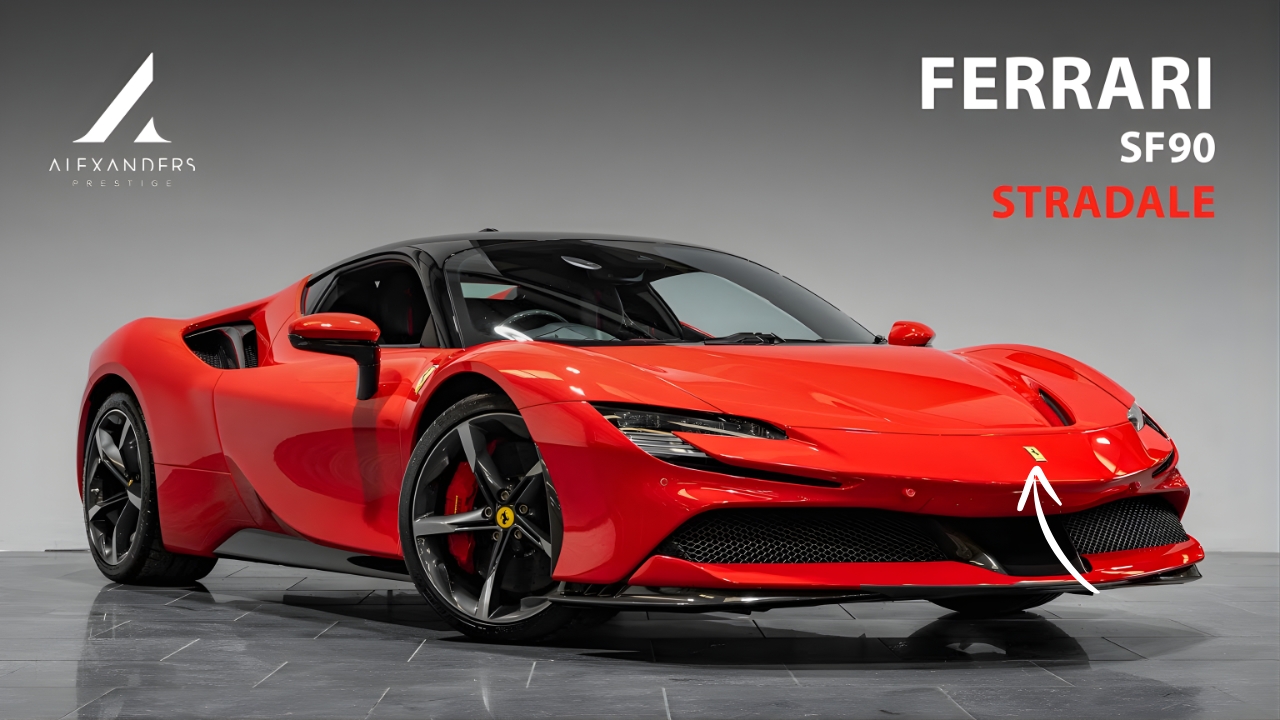
On the design side, mainstream descriptions highlight a forward-set cabin and a transparent engine hatch framed by flying buttresses—details that help explain why the SF90 looks so different even to people who don’t memorize model codes.
The net effect is a car that reads as both futuristic and unmistakably Ferrari, which is exactly what you want in the U.S. luxury-performance space: bold enough for attention, familiar enough for brand comfort.
Inside the Cabin: Digital Ferrari, New Controls
If exterior drama is what pulls people in, the interior technology is what keeps the SF90 conversation going with U.S. buyers who expect high-end interfaces.
Reported details describe an all-digital instrument cluster and touchscreens integrated around Ferrari’s steering wheel controls, including the Manettino and an “eManettino” used to select among multiple power unit modes.
The story here isn’t gadgets for their own sake; it’s control. Ferrari framed the eManettino concept as a way to choose how the car blends gasoline and electric power so the driver can focus on driving while the software manages the complex energy flow behind the scenes.
Where It Fits—and Why That Matters in the U.S.
In the U.S., Ferrari’s lineup hierarchy is part status symbol, part collector logic. Reveal-era reporting positions the SF90 Stradale below the LaFerrari but above the brand’s mid-engine V8 models of its time, effectively creating a new rung for buyers who want something more advanced—and more headline-worthy—than “just” a traditional V8 supercar.
One notable detail from early coverage: price wasn’t disclosed at the time, with reporting indicating dealers expected it to sit below LaFerrari but above Ferrari’s prior mid-engine V8 offerings.
That kind of ambiguity is typical at reveal time, but in the U.S. it also fuels the exact kind of speculation that keeps a car trending long after the first video drop.
What the Ferrari SF90 Stradale Reveal Really Signaled
The SF90 Stradale reveal made one point hard to argue with: Ferrari was willing to put electrification at the center of its performance narrative, not at the margins.
Also Read this – 2026 Chevrolet Silverado 1500 advance tech features, iconic design make roaring in low cost
With 986 horsepower, all-wheel-drive capability, and a plug-in hybrid system designed for the street, the SF90 arrived as a new template for what a Ferrari flagship-style supercar could be in America’s rapidly shifting performance landscape.